



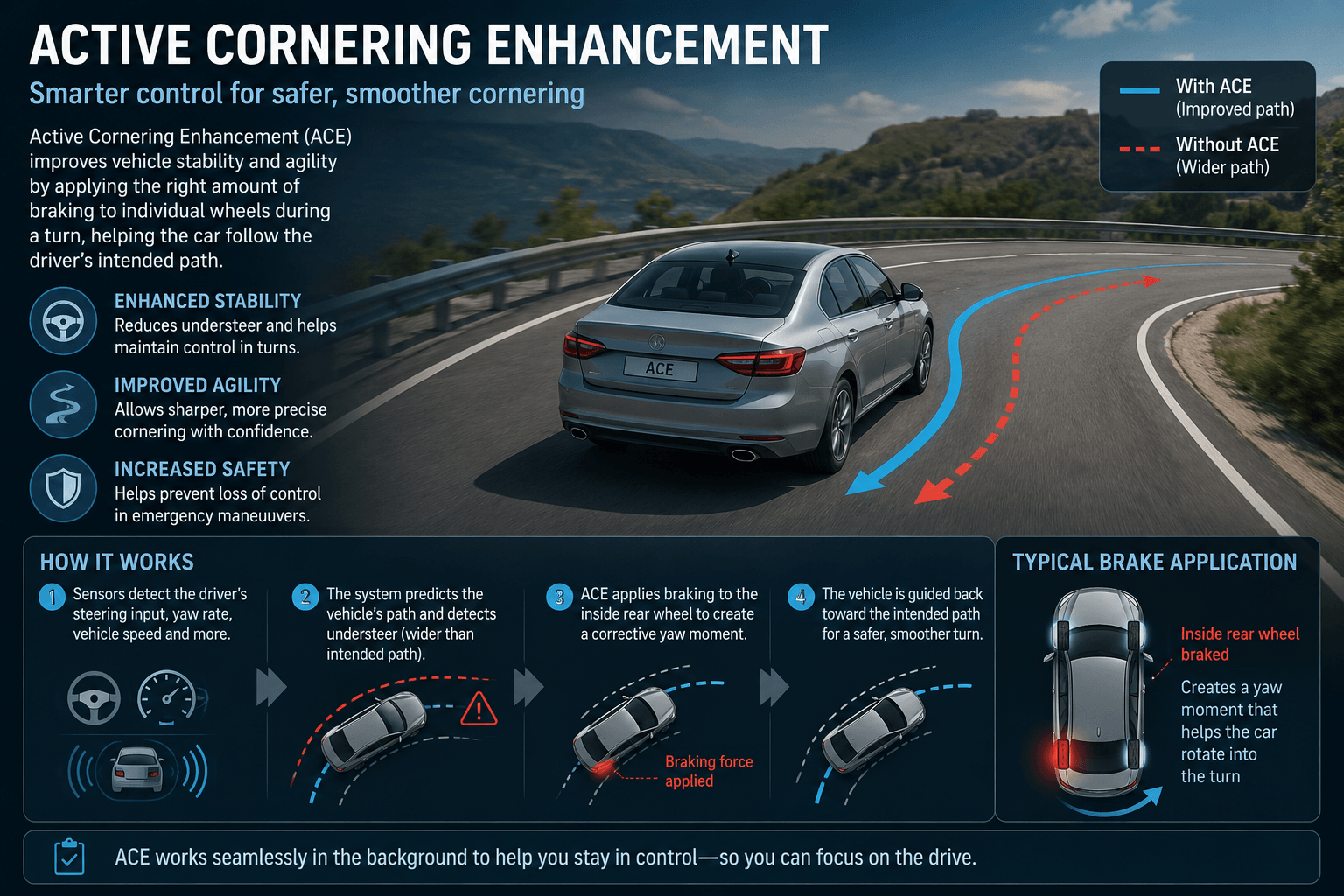
In this day and age, where the competition between vehicle manufacturers is at its peak, the difference between successful and failing cars is often defined by the minutest detail. One such refinement, which has begun to gain considerable ground with the public, is that of active cornering enhancement. Active cornering enhancement is the combination of several mechanical and electronic systems that aid the driver in negotiating turns at varying speeds. By utilising a multitude of different mechanisms, active cornering enhancement improves the driving characteristics of a car, enhancing both safety and enjoyment behind the wheel.
What is Active Cornering Enhancement?
Active cornering enhancement can be summarised as a set of systems that actively assist the driver in maintaining control and stability of the vehicle while making turns. Similar concepts had existed for several years in the form of stability control, but modern-day developments allow for a much more comprehensive approach to the matter. Most noticeably, unlike its predecessors, active cornering enhancement encompasses a wide variety of different technologies and mechanisms that can be implemented individually, together, or not at all.
The first of the key elements of active cornering enhancement is the collection of sensors that provide the necessary data for computations performed by the car’s Central Processing Unit (CPU). Then, using the data provided by the sensors, the CPU controls the vehicle’s torque distribution, ensuring optimal power delivery throughout the drivetrain. Active cornering enhancement typically employs torque vectoring to alter the distribution of torque and induce rotation of the vehicle.
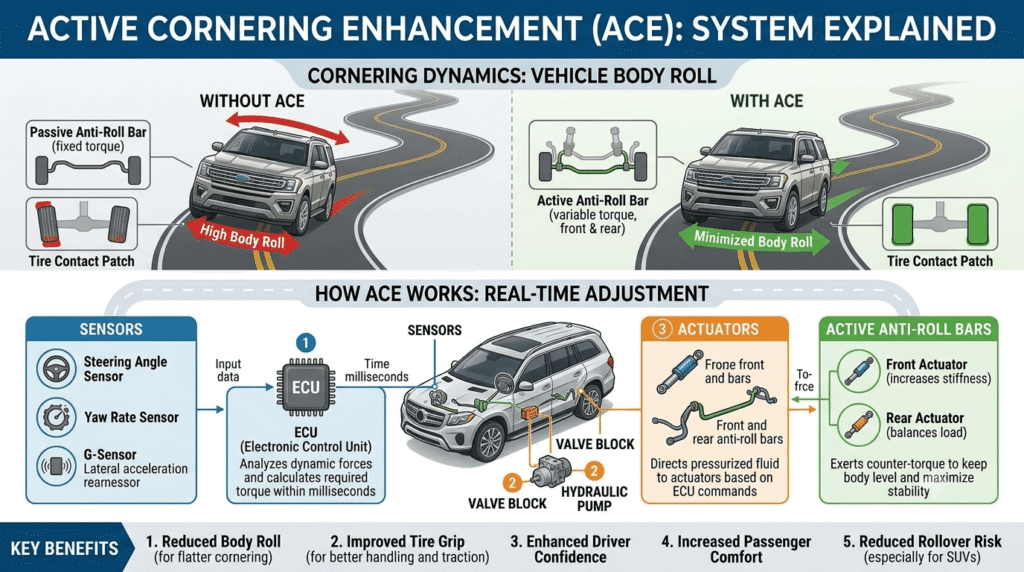
Some implementations make use of electronically controlled, limited-slip differentials in order to perform torque vectoring. Another integral component of active cornering enhancement is active suspension, a system that allows the car to control the dampers’ levels of stiffness. In practice, this attribute enables the vehicle to follow the intended course on the road with ease.
Why is Active Cornering Enhancement Important?
There are a multitude of reasons why the implementation of active cornering enhancement is so important to modern-day vehicles. Above all else, active cornering enhancement enhances safety, which is always a priority for drivers. By reducing the risk of sliding or spinning out of control on the road, especially on wet surfaces and on slippery road conditions, active cornering enhancement can prevent accidents that would otherwise occur.
Additionally, the performance characteristics of the car are vastly improved, since active cornering enhancement allows for faster cornering than would be possible without it. Especially for sports cars, the improvement in performance can be tremendous. This, in turn, means that enthusiasts who wish to enjoy the handling characteristics of their vehicles on race tracks can extract much more performance from the cars than before.
Finally, the introduction of active cornering enhancement leads to improvements in terms of comfort as well. The reduced body roll of active suspension, as well as the improved adherence to the road, ensure that the passengers in the car are able to enjoy a much smoother ride on winding roads and on turns. For luxury cars, the benefits of active cornering enhancement are especially profound, as they allow the vehicles to provide a more composed and comfortable driving experience to their passengers.
Also Read: Software RCSDASSK: A Guide to Understanding and Leveraging It
Active Cornering Enhancement and Different Types of Vehicles
The concept and the technologies that comprise active cornering enhancement have been gradually introduced to different types of vehicles over the years. While initially only available in high-end, premium cars, the inclusion of active cornering enhancement has since made its way into several different makes and models, including sedans, SUVs, and even commercial vehicles.
For SUVs in particular, the inclusion of active cornering enhancement has become a great benefit, since body roll tends to be much more prominent for these types of vehicles, which is especially apparent during sharp turns. The introduction of active cornering to electric vehicles is an interesting prospect, as the technology allows for even more benefits to be extracted from them. Due to their instantaneous power delivery characteristics, electric vehicles are a great fit for utilising torque vectoring. Additionally, the independent control over individual motors in some electric cars provides a unique opportunity for implementing active cornering enhancement.
Finally, the introduction of active cornering to commercial vehicles is primarily driven by the need to enhance the safety characteristics of these vehicles on the road, especially during sharp turns and in the case of sudden manoeuvring. As the technology becomes more widespread, it is only a matter of time before active cornering enhancement becomes available in more affordable cars. As previously mentioned, the implementation of active cornering enhancement has become progressively more prevalent in different types of vehicles.
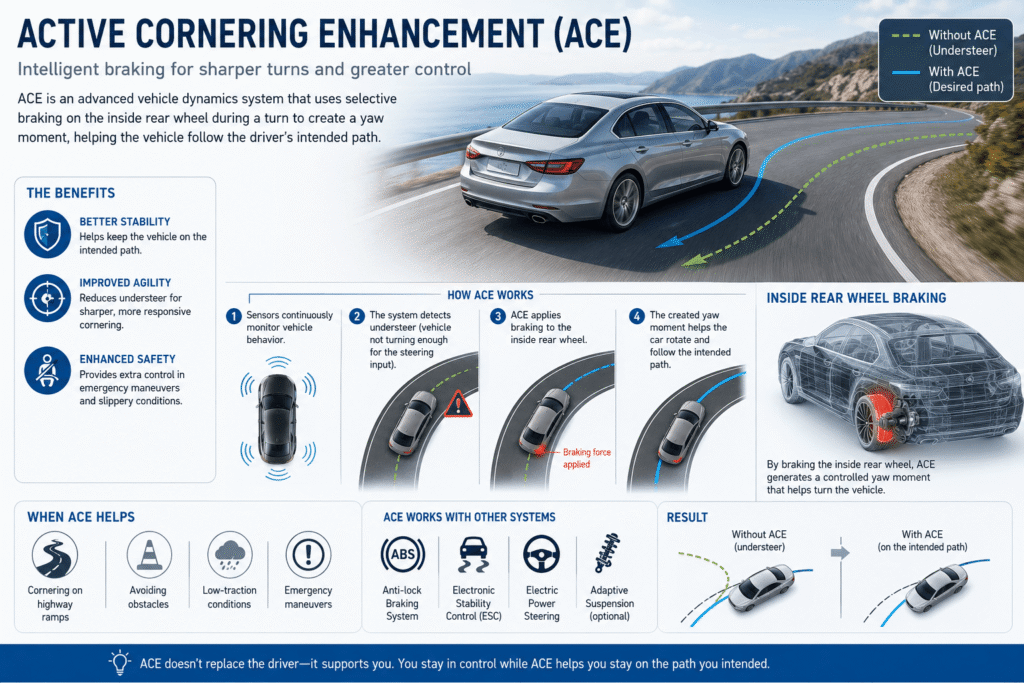
Comparing Active Cornering Enhancement and Traditional Handling Systems
In comparison to traditional handling systems, active cornering enhancement provides much greater flexibility in terms of suspension and throttle response. By being able to dynamically alter these characteristics in real-time, active cornering enhancement ensures that the car is always performing optimally for the current driving conditions. The benefits of active suspension, for instance, are immense, as they provide a great level of comfort to the driver without sacrificing performance. In contrast, traditional suspension systems are much more constrained in their capabilities, as they are only able to provide a single firmness level.
In terms of throttle response, cars with traditional handling systems are only able to offer a single profile, which is less flexible than the wide suite of options available to active cornering enhancement-equipped cars. For instance, if the driver decides to put the car in comfort mode, he or she has to live with its throttle response. Likewise, if the driver wants to enjoy the sportier exhaust sound and throttle response, he or she has to sacrifice the comfort of the car’s ride.
Challenges and Future Developments
Despite all of the benefits that come with implementing active cornering enhancement, there are also some considerable challenges. One of the biggest challenges is the cost, which is much higher than it would be for a traditional suspension or handling system. Additionally, the maintenance and repair costs for the components that comprise active cornering enhancement can also be substantially higher than for traditional systems.
Another notable challenge is presented by the complexity of the control algorithms that have to be implemented for active cornering enhancement. Namely, in cases where the algorithm is improperly implemented, it could interfere too much with the natural response of the car, thus proving more of a hindrance than a benefit. Therefore, it is of utmost importance for manufacturers to spend the required amount of time and effort to optimise the algorithms that control active cornering enhancement.
Looking at the future developments of active cornering enhancement, it is evident that there are many exciting developments to look forward to. In particular, the next generation of active cornering enhancement will likely see the introduction of artificial intelligence and machine learning to the mix. These technologies will allow for implementing much more complex algorithms, thus enabling the cars to behave in much more sophisticated ways.
For example, by utilising video and radar sensors, the car could anticipate upcoming turns and prepare the suspension and torque distribution beforehand, thus allowing for even sharper cornering than is possible today. Especially with the development of autonomous cars, active cornering enhancement will become even more important, as it will allow these vehicles to negotiate turns in a manner that is similar to how a human driver would.
Final Remarks
Overall, the introduction of active cornering enhancement is a great development in terms of enhancing the driving characteristics of modern vehicles. By combining an array of different technologies, active cornering enhancement allows for improving almost every aspect of driving, from safety to performance to comfort. The implementation of these improvements has been witnessed across a wide range of different types of vehicles. As active cornering enhancement continues to evolve and become more sophisticated, it promises much more exciting developments for the future of driving.
FAQS
1. What is active cornering enhancement, and how does it differ from traditional handling systems?
Active cornering enhancement is a set of systems that actively assist the driver in maintaining stability and control of the vehicle while making turns. Traditional handling systems are composed of mechanical parts that are manually adjusted to account for different driving conditions.
2. What components are included in active cornering enhancement?
Torque vectoring devices, active suspension, active anti-roll bars, and, in some cases, rear-wheel steering are the primary components of active cornering enhancement. Together, these devices allow the car to provide a much better driving experience.
3. Does active cornering enhancement increase the safety of the vehicle?
Yes, active cornering enhancement increases the safety of the vehicle by reducing the likelihood of skidding, loss of control, spinning out, and other dangerous consequences. In particular, in bad weather and on wet roads, active cornering enhancement can significantly reduce the risk of the driver sliding on ice.
4. Is active cornering enhancement only available in sports cars?
No, the technology has started to be implemented in other types of vehicles, including sedans and SUVs, with the intent to enhance the driving characteristics of these cars. Especially for SUVs, the inclusion of active cornering enhancement is important because it allows for reducing body roll during sharp turns.
5. Are there any drawbacks to active cornering enhancement?
The main drawbacks of active cornering enhancement pertain to costs. The implementation of the technology makes the cars more expensive. Furthermore, the maintenance and repair costs for such cars can be significantly higher due to the complexity of the components involved in active cornering enhancement. Lastly, the software that controls active cornering enhancement could fail to be properly optimised, thus introducing unnecessary interference with the driving dynamics of the car.